DuoCombo strategy: how to keep the COMBO alive and set up your partner
We make DuoCombo. Every rule and number on this page comes from the game’s own rules code, the same code the server runs, so you can rely on it.
DuoCombo is a co-op block puzzle for two phones: you share one 8×8 board, take turns placing pieces, and full rows or columns clear. Most of the game turns on one shared number, the COMBO. Teams that understand exactly when it grows and when it breaks get much further than teams that just clear lines when they see them. This guide covers the rule, the math behind it, and the habits that carry a pair through all ten stages.
The rule everything depends on
The COMBO survives one placement without a clear. It does not survive two in a row.
It doesn’t matter who made the placement. Every turn either clears at least one line or counts as a miss, and two misses in a row reset the COMBO to zero. Any clear resets the miss count. Here is how that plays out over six turns:
| Turn | Who | What happens | COMBO afterwards |
|---|---|---|---|
| 1 | You | Clear a row | ×1 |
| 2 | Partner | No clear: they leave a row one piece short | ×1, “about to break!” |
| 3 | You | Finish that row | ×2 |
| 4 | Partner | Clear a column | ×3 |
| 5 | You | No clear | ×3, “about to break!” |
| 6 | Partner | No clear | Broken: back to zero |
The game tells you when you are on the last chance. The COMBO badge changes to “×3 about to break!” and your status line says “Your turn · clear a line now!”
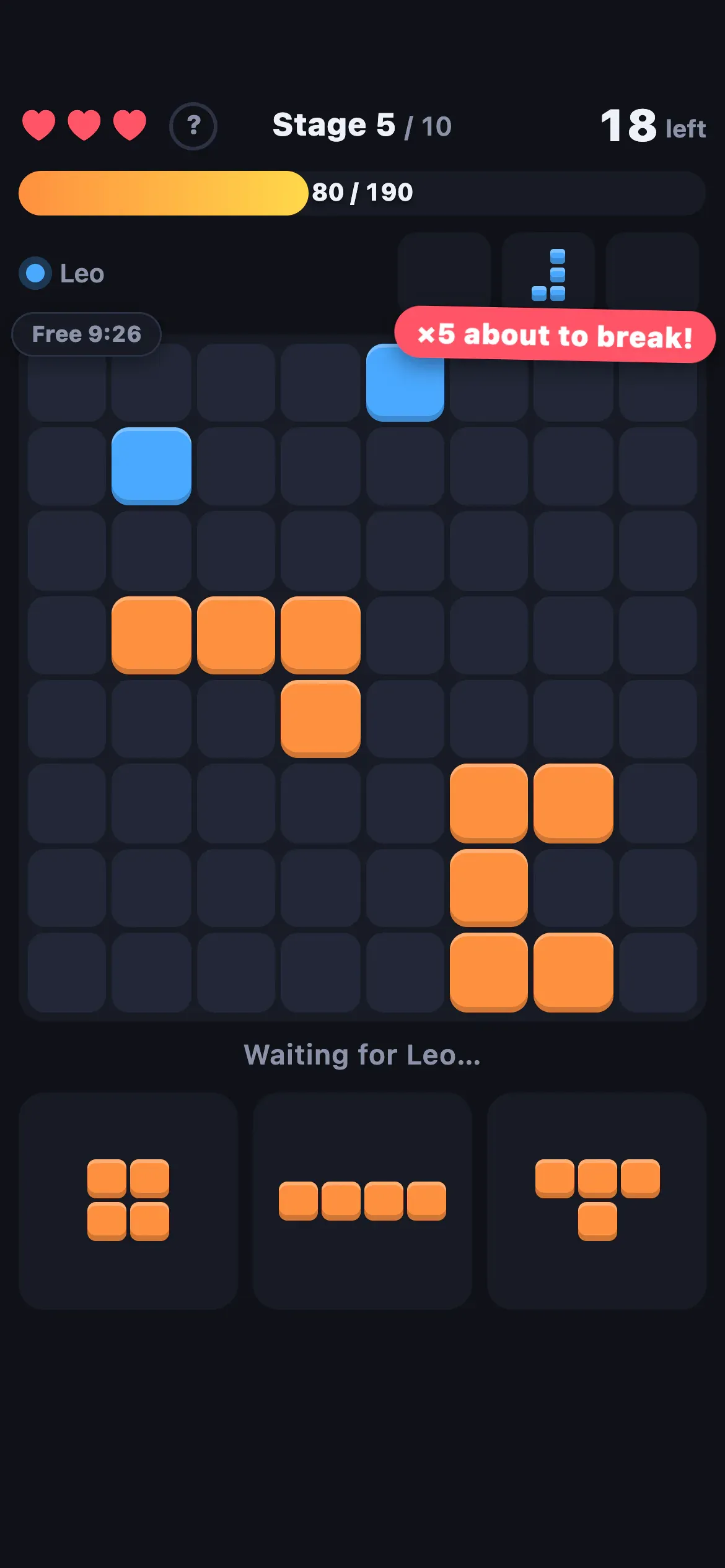
One more way to miss: if none of your three pieces fits anywhere, the game skips you (“Nothing fits, you skip”) and your partner moves again. A skipped turn counts as a turn without a clear, so a cramped board can break a chain even when nobody chose to miss.
How the points add up
Every cleared line adds one to the COMBO and scores 10 × the COMBO, capped at ×5:
| Line in an unbroken chain | Multiplier | Points for that line |
|---|---|---|
| 1st | ×1 | 10 |
| 2nd | ×2 | 20 |
| 3rd | ×3 | 30 |
| 4th | ×4 | 40 |
| 5th and every line after | ×5 (shown as MAX ×5) | 50 |
Two things follow from this table.
- A chain is worth far more than the same lines spread out. Ten single-line clears in one unbroken chain score 400 points (10 + 20 + 30 + 40, then six lines at 50). The same ten clears with the chain breaking in between score 100.
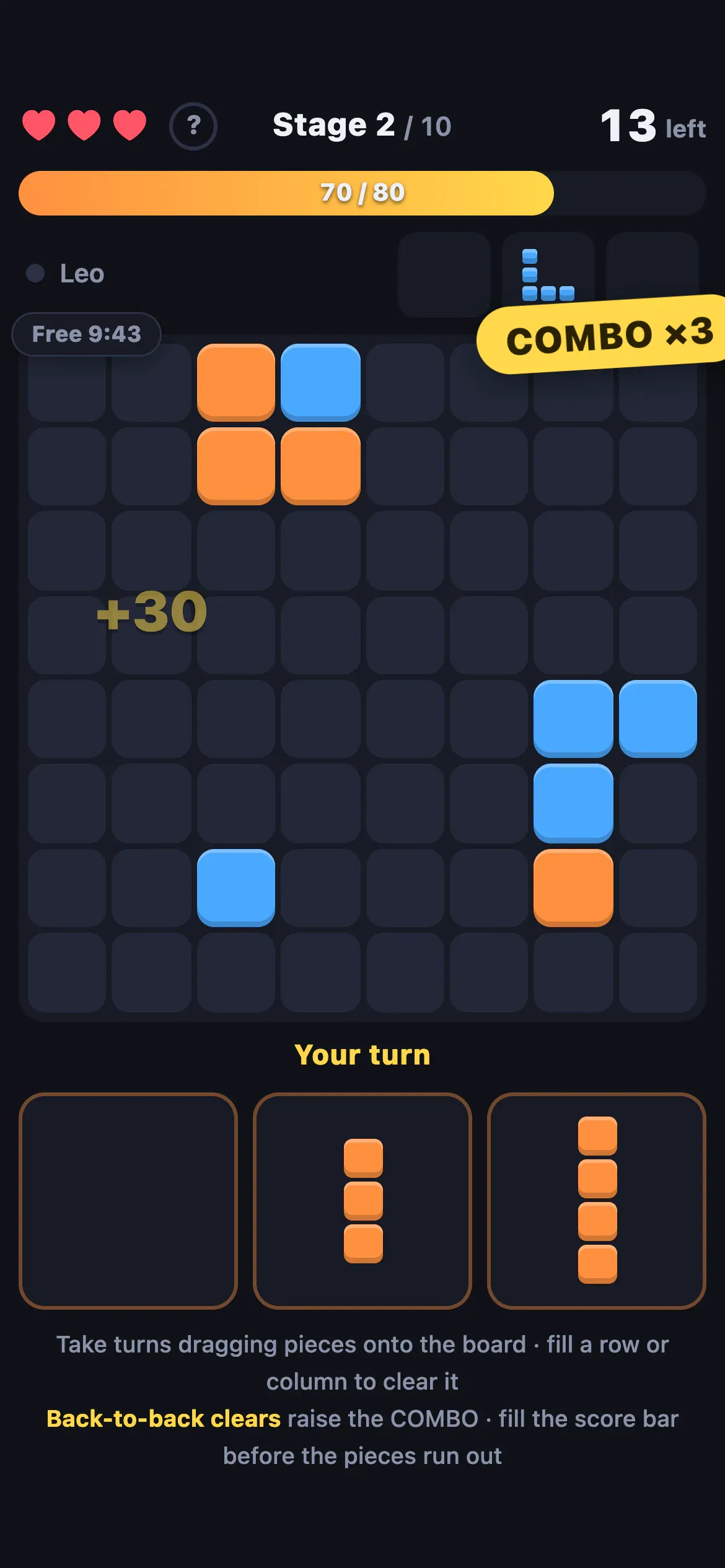
- Lines count one by one, even in the same placement. Clear two lines at once and the COMBO goes up by two. Once the COMBO is at ×4 or higher, a double clear is worth 100 points from a single piece.
The stage math: why the COMBO matters more as you go
Each stage gives the two of you 20 pieces in total, and the target rises every stage:
| Stage | Target | Points needed per piece |
|---|---|---|
| 1 | 50 | 2.5 |
| 2 | 80 | 4 |
| 3 | 110 | 5.5 |
| 4 | 150 | 7.5 |
| 5 | 190 | 9.5 |
| 6 | 240 | 12 |
| 7 | 280 | 14 |
| 8 | 320 | 16 |
| 9 | 370 | 18.5 |
| 10 | 420 | 21 |
The first stages forgive almost anything. By stage 10 you need 21 points per piece, which is only possible with a long chain. A useful benchmark: if you start stage 10 with the COMBO already at ×5, clearing on every second placement (10 clears from 20 pieces) scores 500 points, comfortably above 420. Start stage 10 from zero and the same rhythm scores 400, just short.
That works because the COMBO carries over from stage to stage. So do points above a target: reach 95 on an 80-point stage and you begin the next stage with 15 already scored. When you hit a target the stage ends at once, and every unused piece adds 5 bonus points to your run’s total score.
Nine habits of teams that reach stage 10
1. Play in pairs: one sets up, the other cashes in
Because one miss is free, the natural rhythm is a relay. If you can’t clear on your turn, use it to leave a row or column one piece from complete for your partner. They clear, the miss count resets and the COMBO climbs. Clearing on every turn is better still, but the relay is the floor you never want to drop below.
2. Read your partner’s tray before you place
Your partner’s three pieces are always on your screen, in the small tray at the top. Don’t just leave a gap: leave a gap their pieces can fill. A row missing three cells in a line is perfect if they hold a 1×3 bar and useless if all they have is a 2×2 square. Pieces never rotate, so the shape has to match exactly.
3. When the badge says “about to break”, clear, even if it’s ugly
“About to break!” means the last placement didn’t clear. A clear now, even one that leaves the board messier, keeps the chain alive. A beautiful setup that doesn’t clear ends it. Fix the board on the next turn.
4. Build crossings for double clears
A row and a column that are both nearly full and share an empty cell can be finished by one piece. That’s two lines: the COMBO goes up by two, and at ×4 or higher you score 100 points. When you set up, look for the shared corner.
5. Keep room for the big pieces
The pieces range from a single square to a 3×3 block and 1×5 bars, and none of them rotate. If nothing in a player’s tray fits, that turn is skipped, and the skip counts as a miss. If neither of you can place anything, the board jams: it’s wiped, the COMBO resets and the stage loses 3 pieces. Keep a few open lanes, such as an empty 3×3 area and at least one row or column with plenty of free cells, so that whatever comes next has somewhere to go.
6. Choose the order of your three pieces
You only get new pieces after you’ve used all three. That means the last piece in your tray is the one you’ll be forced to place, wherever it fits. Play awkward, bulky pieces early while the board still has room, and keep a small, flexible piece for last.
7. Point instead of talking
Tap a square on the board and it flashes on your partner’s screen. Use it to say “the line is here” or “your bar goes here”. Before your partner drops a piece you can also watch their live drag preview, so you’ll know what they’re about to do. If you’re playing apart and want to talk too, keep a phone or video call open: DuoCombo has no voice chat of its own.
8. Carry the chain into the next stage
When you’re close to a target, don’t give up the chain to finish one placement sooner. The COMBO comes with you into the next stage, while an early finish is only worth 5 bonus points per unused piece. On the later stages, entering with ×5 is worth much more than a few bonus points.
9. When a stage is lost, set up the retry
If the pieces run out below the target, you lose one of your three hearts and replay the stage, but the board and the COMBO stay exactly as they were. So in the last few pieces of a stage you can no longer win, stop gambling. Open up space, avoid a second miss, and hand the retry a clean board with the chain still alive.
In the daily challenge
The daily challenge uses the same board, the same scoring and the same one-miss rule, in a different shape:
- 40 pieces between you, one stage, no hearts. There’s no target to clear and nothing carries over: the run ends when the 40th piece is placed, and your score earns a bronze, silver or gold medal.
- Everyone gets the same pieces that day, so the day’s leaderboard compares teams on exactly the same puzzle.
- One try each per day. It’s free, but there’s no second attempt, so don’t treat it as practice.
What that changes in practice:
- Habits 1 to 7 matter even more. With only 40 pieces every turn without a clear is expensive, and a jam costs 3 of the 40.
- Habits 8 and 9 don’t apply: there’s no next stage to carry the COMBO into and no retry.
- Start the chain early. The first four lines of a chain score 10 to 40 points; from the fifth line on, each line is worth 50. The sooner the chain is going, the more of your 40 pieces clear at 50 a line.
In endless mode
Endless mode uses the same scoring, the same one-miss rule and the same 20-piece stages, but there’s no last stage: your result is the depth you reach.
- Hearts come back. Every 5th stage cleared returns a heart (up to 3), so a lost heart isn’t gone for good. Habit 9 matters even more here: a missed stage is replayed with the board and the COMBO kept.
- The board changes as you go deeper. From depth 11 every stage starts with a few stones on the board. They clear like any other cell, so a row with a stone in it is just one more line to finish. From depth 21 big pieces come more often, which makes habit 5 (keep room) the one that decides how deep you get; from depth 31 corners, L, S and T shapes are more common and single squares rarer.
- Carry the chain. Points above a target and the COMBO carry into the next stage, as in the normal game, so habit 8 applies at every stage.
- Take breaks at checkpoints. The run is saved with its room after every move, and the game marks every 5th stage as a checkpoint. Stop whenever you like; to carry on, one of you taps Endless mode in the lobby and the same partner joins the new room. A room left for 3 days without activity is deleted with its run, but the depth you reached stays on the endless leaderboard.
Common mistakes
- Setting up for yourself. Your partner moves next. A setup that only your own next piece can finish has to survive their turn first.
- Lots of nearly full lines that nothing can finish. Three rows each missing one awkward cell are worth less than one row missing a gap that a common piece fills.
- Placing in a panic at “about to break”. Check each of your three pieces against every nearly full line before you drag anything.
- Leaving the 3×3 block for later. By the time it’s your last piece, there may be nowhere left to put it.
After a run
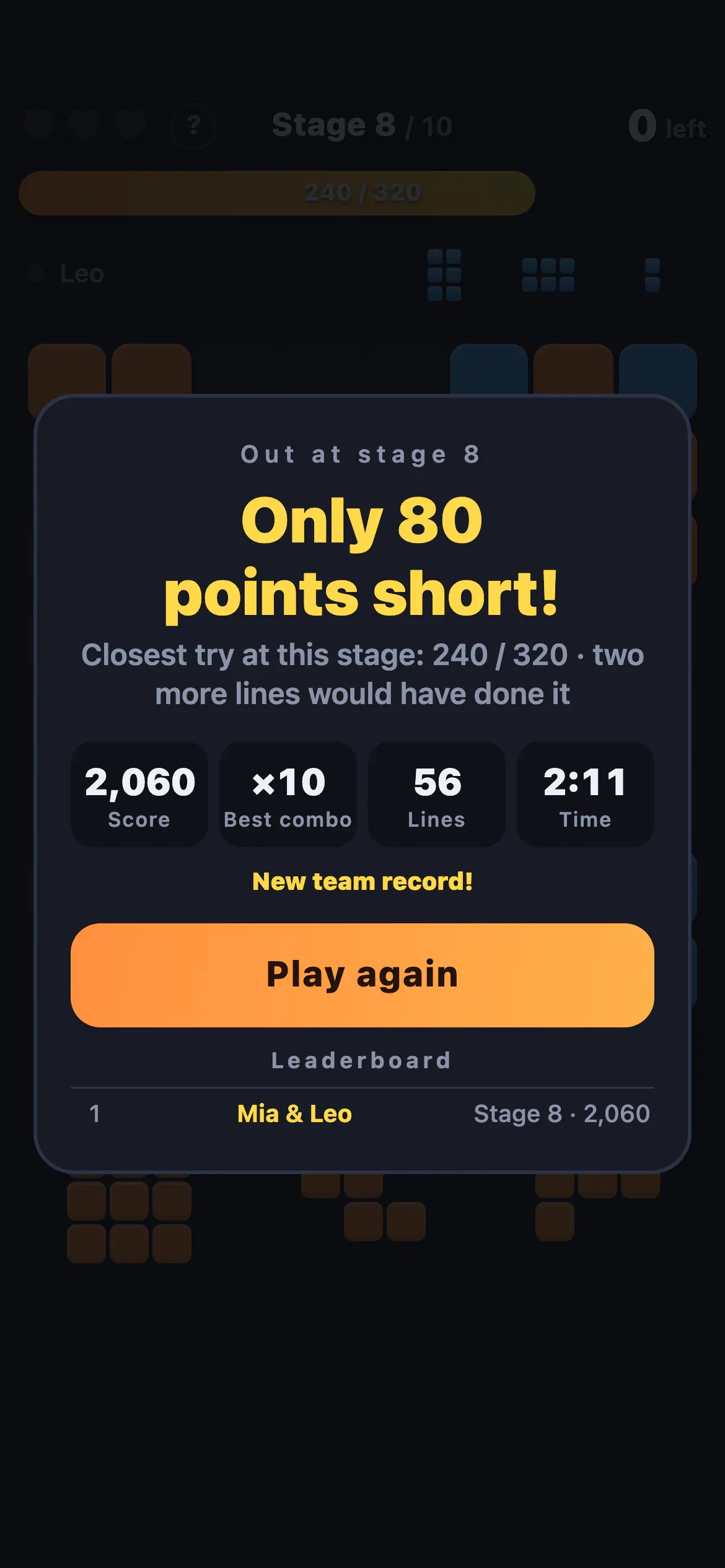
Lose a run and the end screen tells you exactly how many points short you were, so you’ll know whether one more line would have done it. Clear all ten stages and the next run starts one ★ harder, with every target raised by 8% for each ★.
Quick reference
- One shared 8×8 board. Each player holds 3 pieces, visible to both, and gets new ones only after using all three. Pieces never rotate.
- Turns alternate. If nothing fits, you’re skipped, and that counts as a miss.
- Every cleared line: +1 COMBO and 10 × COMBO points, up to ×5.
- The COMBO survives one miss and resets after two in a row.
- 10 stages of 20 pieces (both players together), targets from 50 to 420, 3 hearts. A failed stage keeps the board and the COMBO.
- Jam (nobody can move): the board is wiped, the COMBO resets and the stage loses 3 pieces.
- Points above a target carry over; each unused piece at a stage clear adds 5 to the run score.
- Daily challenge: 40 pieces, one stage, no hearts, the same pieces for everyone; one free run per player per day; your score earns a medal.
- Endless mode: no last stage, the result is the depth; a heart back every 5th stage; stones from depth 11, more big pieces from 21, odd shapes from 31; saved with its room after every move.